
The history of freshwater pearls begins with rivers and lakes, where people discovered pearls inside freshwater mussels and began to recognize their value. Over time, people learned to search for them, trade them, and use them in jewelry and ornamentation. As knowledge of mussels and pearl formation developed, people eventually found ways to influence how pearls formed, laying the foundation for modern freshwater pearl farming.
From ancient river valleys to modern pearl farms, the story of freshwater pearls has unfolded across different regions and cultures. Each developed its own traditions, techniques, and uses for these natural treasures, shaping the freshwater pearl industry we know today.
From Ancient Times On: Pearls Enter Everyday Life
In North America, people have used freshwater mussels for thousands of years. Archaeological evidence shows that Indigenous communities in the Tennessee and Ohio River valleys gathered mussels and used their shells and pearls to make ornaments. GIA has also documented freshwater pearls from Hopewell cultural sites dating from about 200 B.C. to A.D. 200.
These discoveries offer a glimpse into how early communities encountered freshwater pearls. A pearl found inside a river mussel was a rare and unexpected find, making it something worth keeping, wearing, or trading.
Pearls also found their way into myths and literature. Many cultures associated them with tears. In one Arab tale, a pearl is described as a goddess’s tear. A Danish story tells of a mother mussel protecting the tears of the Mermaid Princess. China has its own tradition, including the story of the Jiaoren, a mythical figure whose tears became pearls.
Early Chinese writings also mention pearls. The Book of Documents refers to “pearls and fish from the Huaiyi.” Later interpretations have generally understood the “pearls” in this passage as freshwater pearls associated with mussels from the Huai River region.
Japan developed a similar cultural connection with pearls. Later accounts of Lake Biwa pearls often point to imagery in the Man’yōshū, one of Japan’s earliest major collections of poetry. Whether or not those literary references describe actual pearl harvesting, they show how long pearls have been part of Japan’s cultural and literary tradition.
From Roman Times to the Middle Ages: River Pearls in Europe and Pearl Cultivation in China
Freshwater pearls were already valuable in Europe by Roman times. People harvested pearl mussels from rivers, and natural freshwater pearls became part of European jewelry and wealth.
China took a different path. Instead of simply searching for naturally occurring pearls, people began experimenting with ways to make mussels form nacre around objects placed inside them.
One important example is preserved by the German Gemmological Institute in Hamburg: a Chinese Buddha-shaped pearl attached to a mussel shell.
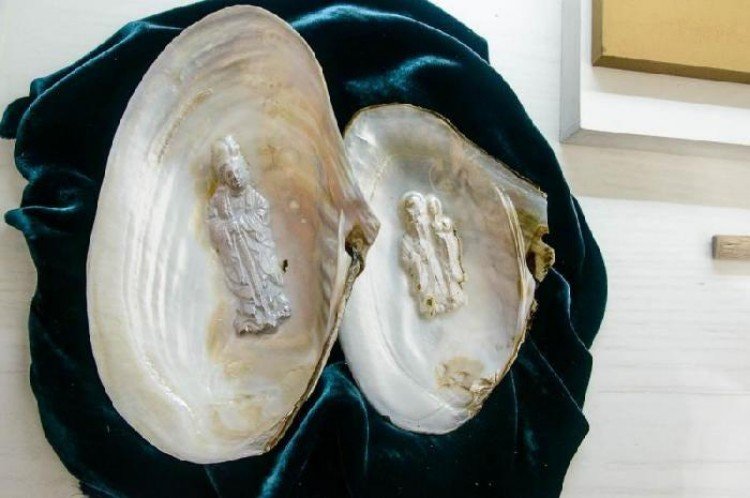
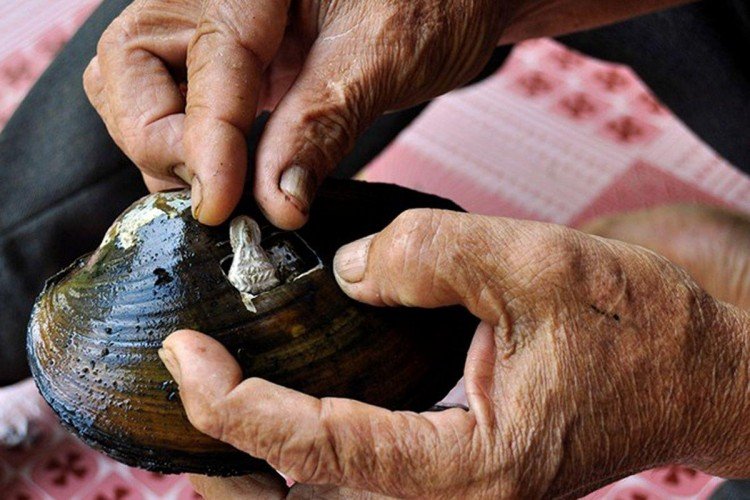
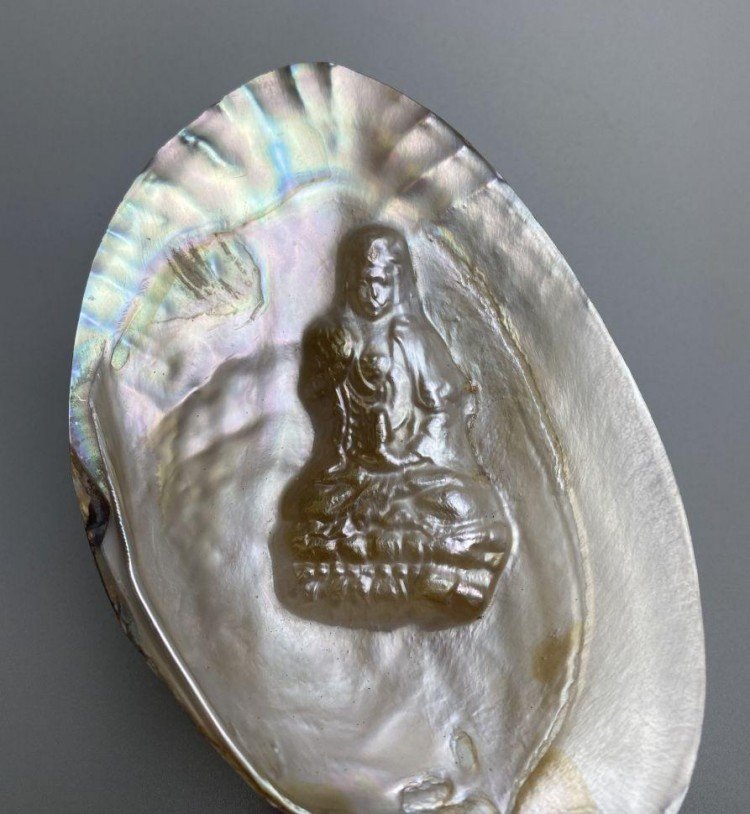
The technique dates back to the Southern Song dynasty. According to historical accounts, Ye Jinyang, a local resident of Huzhou, placed small carved figures made from tin and other metals, wood, or bone between the mussel’s shell and mantle tissue. The mussel gradually covered the object with nacre, producing a Buddha-shaped pearl attached to the inside of the shell.
This was very different from the round, free-form freshwater pearls produced by modern farms, but the basic idea was important: instead of waiting for a pearl to form by chance, people were deliberately influencing the process. China was among the earliest places where this kind of pearl cultivation developed, laying part of the groundwork for later advances in pearl culture.
From the Song to the Qing Dynasties: Dongzhu Pearls Become Imperial Treasures
In northeastern China, another pearl tradition was based on harvesting pearls from the wild.
Historical records from the Northern Song dynasty mention Dongzhu pearls from the Songhua River and its tributaries. During the Ming dynasty, tribute and trade involving Jurchen communities brought Dongzhu pearls into wider political and commercial networks. Under the Qing dynasty, their collection came under increasingly strict government control.
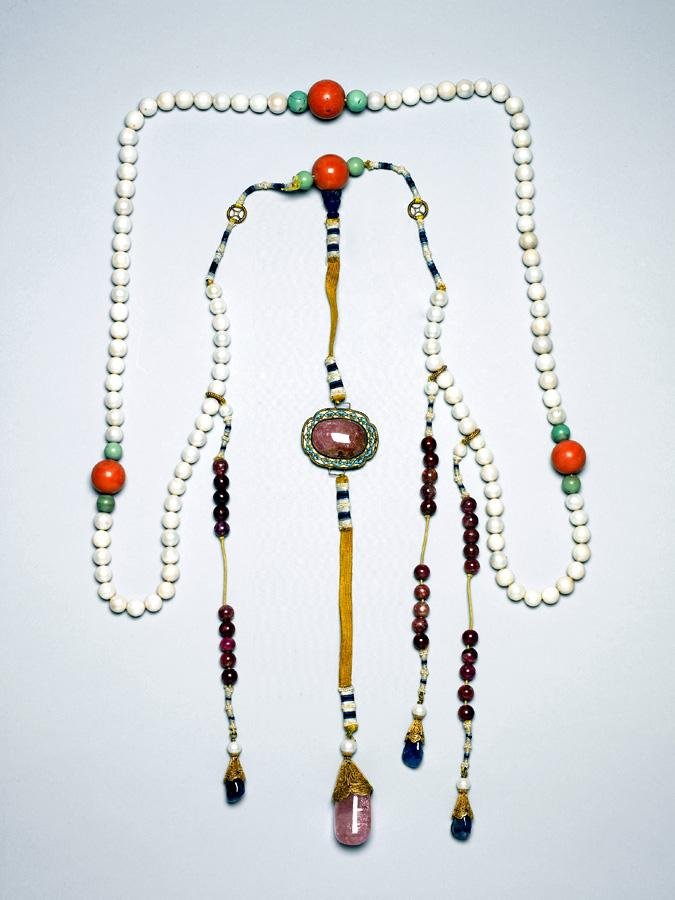
By the Qing period, the system for collecting Dongzhu pearls was well established. Palace Museum records show that official pearl-collecting institutions operated in northeastern China during the reigns of the Shunzhi and Kangxi emperors, with registered pearl harvesters responsible for collecting them. The system expanded further under the Qianlong emperor.
Dongzhu pearls became important symbols of status at the imperial court. They were used in court necklaces, hats, and other items associated with rank and ceremony.
That demand came with a cost. Heavy harvesting put increasing pressure on wild pearl resources. By the later Qianlong period, historical records mention suspending pearl collection to allow the resources to recover. The experience of Dongzhu pearls is an early example of a problem that would appear again and again in the history of freshwater pearls: wild mussel populations cannot support unlimited harvesting.
From the 16th to the 19th Century: European River Fisheries and North America’s Pearl Rush
When Spanish explorers entered North America in the 16th century, they described Indigenous people wearing beadwork and shell ornaments.
As European settlement expanded, freshwater mussels in North American rivers and lakes attracted increasing commercial interest. By the 19th century, natural freshwater pearls had sparked a genuine pearl rush in several parts of the continent.
Pearl fishing was also an established activity in parts of Europe. A historical study of Russia’s White Sea region identifies several rivers where people fished for pearls from the 17th through the 20th century. In some communities, pearl fishing supported a long-running local trade. Scotland also has a long history of natural freshwater pearls, including the famous Abernethy Pearl, which was found in a Scottish river and later set into jewelry.
Some European pearl fisheries left surprisingly detailed records. A historical source cited in a Council of Europe action plan estimates that about 158,000 pearls were collected in Bavaria between 1814 and 1857. It also estimates that finding a single pearl could require opening nearly 3,000 mussels.
Those numbers give a sense of just how difficult natural pearl fishing could be. A pearl might be valuable once it was found, but finding one often required harvesting and opening thousands of mussels first.
The trend became especially pronounced in the United States. From the mid-19th century onward, natural freshwater pearls were found in New Jersey, Ohio, Wisconsin, Arkansas, Tennessee, and other states. News of valuable finds attracted large numbers of pearl hunters. Some people searched specifically for pearls, while others discovered them by chance while harvesting mussels for other purposes.
But pearls were not the main reason North American mussels became a major commercial resource. Their shells were.
In 1891, a freshwater mussel-shell button industry began expanding in Muscatine, Iowa. By 1898, a U.S. Fish Commission survey had documented communities in Iowa and Illinois that depended on the trade. The survey also warned that intensive harvesting was rapidly reducing mussel beds in local rivers.
A large-scale industry had developed around the shells themselves. Mussels were harvested in huge numbers, and their shells were cut and polished into mother-of-pearl buttons. Any natural pearl found inside was simply an unexpected bonus.
The button industry began to decline during the first half of the 20th century. Depleted mussel populations were part of the problem, but changing fashions, the rise of plastic buttons, and competition from overseas manufacturers also contributed. By the 1940s and 1950s, the traditional mother-of-pearl button trade had declined sharply in many areas.
The Mid-20th Century: U.S. Mussel Shells Support Japan’s Pearl Industry
The decline of the button industry did not mean American mussel shells had reached the end of their useful life. Instead, they found a new role in the international pearl trade.
After World War II, shells from American freshwater mussels became an important source of bead nuclei for Japan’s saltwater pearl industry. Manufacturers cut and shaped the shells into round nuclei, which were then implanted into saltwater pearl oysters. As the oysters grew, they deposited layers of nacre around the nuclei, eventually producing cultured saltwater pearls.
In this way, an industry that had once supplied North American button makers became part of Japan’s pearl-farming economy. American mussel shells supplied the raw material, while Japanese pearl farmers provided the expertise needed to turn those nuclei into cultured pearls.

Japan was also developing its own freshwater pearl industry. At Lake Biwa, Masakazu Fujita and other researchers began experimenting with freshwater pearl cultivation in the early 20th century. The industry developed gradually, and sources give different dates for its early milestones because some refer to research, others to successful experiments, and others to the beginning of commercial production.
By the 1930s, however, a commercial Biwa pearl industry was taking shape. World War II interrupted production, but pearl farming resumed after the war.
The Mid-to-Late 20th Century: Lake Biwa Thrives as China Scales Up
After the war, Lake Biwa’s pearl industry expanded rapidly. Around 1970 to 1980, annual production reached roughly six to seven tons. Biwa pearls found buyers in markets including the Middle East and India, and Lake Biwa became one of Japan’s best-known freshwater pearl-producing regions.
The boom eventually came to an end. As suitable mussel supplies became harder to maintain, some farmers moved production to Lake Kasumigaura in Ibaraki Prefecture. At the same time, changes in Lake Biwa’s water quality, ecology, mussel populations, and farming conditions affected the industry.
Production eventually fell sharply. The decline was not caused by a single problem. Changes in the lake environment, mussel availability, farming practices, and the economics of pearl production all played a role.
While Japan’s freshwater pearl industry was developing, China was building a modern freshwater pearl industry of its own.
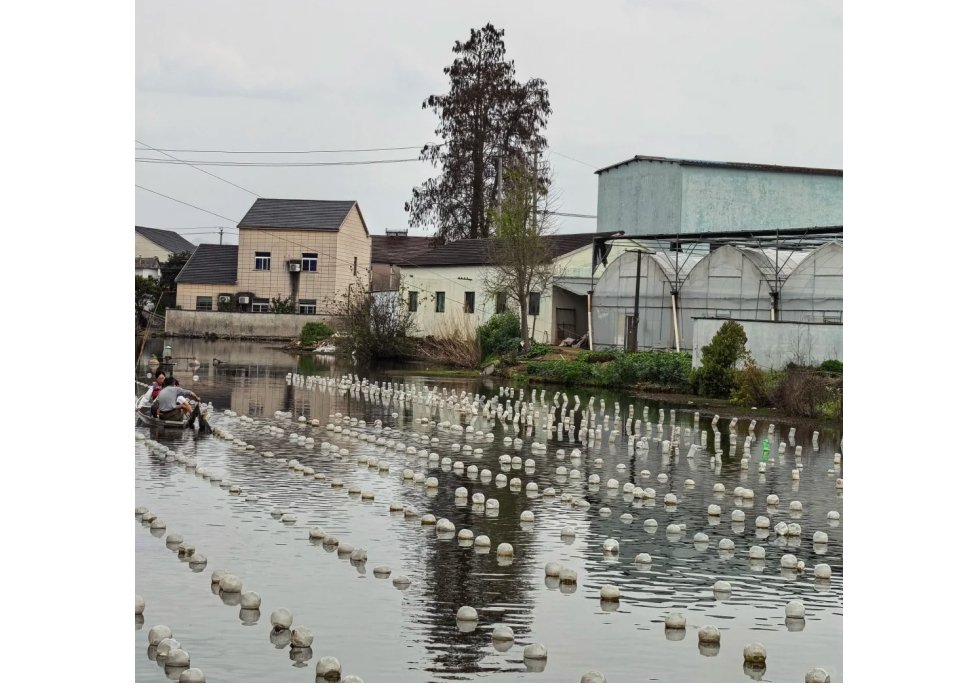
There is no single agreed-upon date for the beginning of modern freshwater pearl farming in China. Some sources trace early experiments to the late 1950s, while others place the start of commercial production in the late 1960s or early 1970s. The difference comes down to what counts as the “beginning”—the first experiment, the first successful harvest, or the point when commercial production became established.
By the late 1960s and early 1970s, China was moving toward large-scale freshwater pearl production. Early cultured pearls often varied considerably in shape and surface quality. As farmers gained experience, improved their techniques, and became more selective about mussels and growing conditions, they were able to produce a wider range of pearl shapes, sizes, colors, and luster.
The United States also experimented with modern freshwater pearl farming. Research began in Tennessee in 1963, and the first U.S. bead-nucleated freshwater pearls were harvested in 1983 after years of experimentation. Compared with the large-scale industry that later developed in China, however, U.S. freshwater pearl farming remained relatively small and experimental.
From the Late 20th Century to Today: A Global Market and a Growing Focus on Conservation
China’s freshwater pearl industry continued to expand through the 1980s. By the 1990s, farming techniques and pearl quality had improved significantly, and China had become a major source of freshwater pearls for the global market.
Meanwhile, another part of the freshwater pearl story was becoming increasingly important in Europe. Wild populations of the freshwater pearl mussel (Margaritifera margaritifera) were declining across many parts of its range.
Pearl harvesting was only one factor. Pollution, river modification, sediment buildup, and declines in the fish that young mussels depend on have all affected the species. As a result, many European regions gradually shifted their focus away from pearl fishing and toward protecting the mussels and the rivers they need to survive.
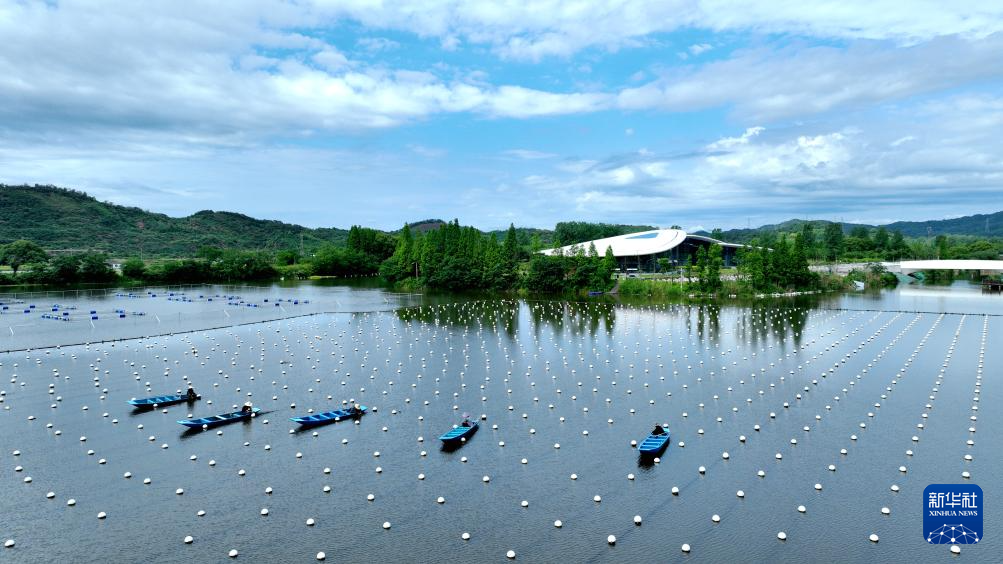
Conservation efforts have included improving water quality, restoring river habitats, protecting host fish, and reintroducing mussels to suitable waterways.
Freshwater pearls have always been connected to rivers and lakes.
People once searched riverbeds for pearls that formed entirely by chance. Later, they learned how to influence pearl formation. Today, pearl farms make it possible to produce freshwater pearls on a much larger and more consistent scale. But the basic relationship has not changed: freshwater pearls still depend on mussels, water, and the environments where those mussels can thrive.
The history of freshwater pearls is therefore more than a story about jewelry. It is also a story about discovery, craftsmanship, trade, and the changing relationship between people and natural resources.
From ancient river valleys to the Dongzhu pearls of China’s imperial court, from European pearl fisheries to Lake Biwa, and from North American mussel beds to China’s modern pearl farms, the story has continued to evolve. What began with people finding rare pearls in the wild eventually became a sophisticated global industry—one that still depends on the rivers, lakes, and mussels at its foundation.