
A freshwater pearl does not become a piece of jewelry immediately after it is harvested.
From the moment a pearl is removed from a cultured freshwater mussel, it begins a careful journey that involves sorting, cleaning, preparation, matching, and skilled craftsmanship. Each step can influence the pearl’s final appearance, durability, and value.
For freshwater pearl producers, the process is not simply about turning loose pearls into jewelry. It is about identifying the unique characteristics of each pearl and selecting the right materials for different designs.
A necklace, pair of earrings, or pearl ring may contain only a few carefully selected pearls, but those pearls often come from a much larger harvest. Understanding how freshwater pearls are processed helps explain why pearls of similar size can have very different quality and price levels.
Step 1: Harvesting and Sorting Pearls
The journey begins when cultured freshwater pearls are harvested from mussels.
China has been the world’s leading producer of freshwater pearls for many years, with extensive experience in pearl cultivation and processing. After harvesting, pearls may carry moisture, organic residue, and other materials from the mussel and growing environment. Initial cleaning and proper handling are therefore important before the pearls move into grading and processing.
A single harvest can contain pearls with significant differences in size, shape, color, luster, and surface condition. Sorting helps separate these pearls according to their characteristics and determine the most suitable use for each one.
Traditionally, much of this work was done by hand by experienced pearl workers. Today, commercial pearl processing often combines manual inspection with specialized sorting equipment. Automated sorting systems can process hundreds of pearls per minute and help separate them according to visible characteristics such as size and shape, making them particularly useful when large quantities of pearls need to be processed. Human inspection remains important for handling the natural variation found in freshwater pearls.
In China, pearl evaluation may also refer to standards such as GB/T 18781—2008. These standards provide a framework for evaluating pearl characteristics, but in practical production, sorting is ultimately about matching the right pearls to the right application.
The detailed characteristics used to evaluate pearl quality—including color, size, shape, luster, and surface quality—deserve a closer look of their own and are covered separately in our guide to freshwater pearl quality and grading.
Step 2: Cleaning, Preparation, and Processing
After sorting, the pearls move into a series of preparation and processing steps that make them suitable for jewelry production. Cleaning comes first, followed by preparation, drilling, and other processing as required by the pearl’s intended use.
Cleaning and Preparing the Pearls
Freshly harvested freshwater pearls may still carry natural fluids, organic residue, and other material from the cultivation and harvesting process. Before they can be drilled, matched, or assembled into jewelry, they need to be cleaned and properly prepared.
In the cleaning process, the pearls are soaked in a neutral detergent solution for 24 hours and kept in a dark place away from direct light during this period. Direct sunlight can affect the calcium carbonate structure in the outer nacre layer and may reduce the long-term stability of the pearl’s luster. After soaking, the pearls are rinsed three times with distilled water to remove any remaining detergent residue.
Careful handling is important throughout the process. Freshwater pearls have a natural nacre surface, so cleaning is intended to remove residue without unnecessarily affecting the surface of the pearl. Once cleaning is complete, the pearls can move on to the next processing stage, such as drilling, matching, or other finishing work.
Drilling Freshwater Pearls
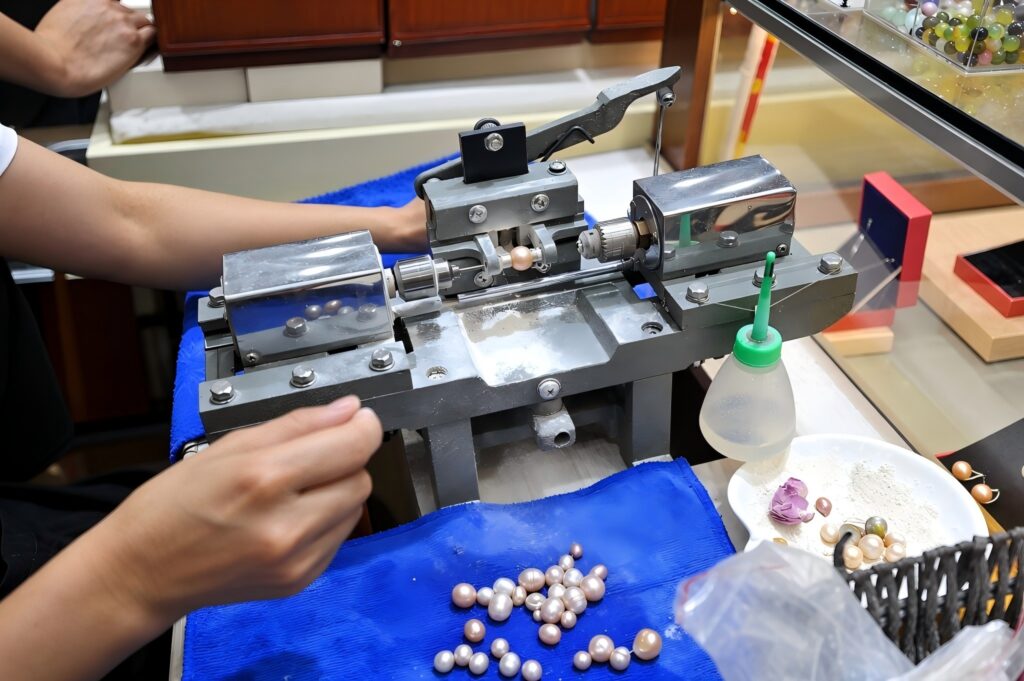
Drilling is one of the most precise steps in pearl jewelry production. Although creating a hole may seem straightforward, freshwater pearls are relatively delicate, and an incorrectly positioned or oversized hole can weaken the pearl or affect how securely it can be assembled into jewelry.
The type of hole depends on the jewelry design. A full hole passes completely through the pearl and is commonly used for necklaces and bracelets. A partial hole is used when the pearl needs to be attached to a finding, such as in earrings, pendants, or rings.
The position of the hole is particularly important. During production, the drilling point should avoid visible blemishes and other weak areas whenever possible. The hole diameter also needs to be controlled carefully, with an allowable variation of about 0.1 mm. If the hole is too large, too small, or incorrectly positioned, the pearl may not fit the jewelry component properly and can be more vulnerable to damage during stringing or assembly.
Production experience also shows how much a small deviation can matter. A drilling-position deviation of just 1 mm can increase the risk of pearl breakage by approximately 40%. For this reason, drilling requires careful positioning based on the pearl’s shape, surface condition, and intended jewelry application.
Purifying Freshwater Pearls
After drilling, the pearls undergo a purification process to remove impurities and further prepare them for jewelry production. Purification can be divided into natural purification and technical purification, depending on the condition of the pearls.
Natural purification involves placing the pearls in a temperature- and humidity-controlled environment and allowing them to rest for seven days. During this period, the pearls naturally release impurities without the use of chemical treatments.
Pearls with dull luster or noticeable discoloration may require technical purification. In this process, the pearls are soaked in a diluted solution of hydrogen peroxide combined with a mildly alkaline solution. The concentration of the solution is critical. If the concentration is too low, it may not remove impurities effectively. If it is too high, it can corrode the outer surface of the pearl and affect its appearance.
After technical purification, the pearls are placed in an ultrasonic cleaning machine for 10 minutes to remove any remaining solution. This final cleaning step helps ensure that chemical residues are removed before the pearls proceed to subsequent processing.
Step 3: Enhancing Pearl Quality — Improving Luster and Durability
After purification, some pearls undergo additional processes designed to enhance their appearance and durability. These processes do not change the fundamental nature of the pearl. Instead, they use physical or surface treatments to improve specific characteristics, primarily luster and durability.
Enhancing Pearl Luster
Luster enhancement is carried out in a vacuum environment. The pearls are placed in a vacuum filtration device and kept under vacuum for approximately 25 minutes. A specialized luster-enhancing solution is then introduced, and the pearls are soaked in the solution for half a day.
The solution is designed to absorb ultraviolet light and convert it into visible light, which can increase the apparent luster of the pearls by more than 30%. Colored pearls may also appear more vivid after this process.
Artificially dyed pearls require particular attention when their color is evaluated. In dyed pearls, color may become more concentrated in surface crevices and other recessed areas. These differences can be examined under a magnifying glass when assessing whether a pearl has been artificially colored.
Strengthening the Pearl Surface
Surface strengthening is mainly used for pearls with relatively thin nacre. A protein solution extracted from natural shell material is applied to the pearl’s surface, forming a protective film.
This protective layer helps reduce damage caused by friction and can increase the pearl’s durability by approximately 50%. After the strengthening treatment, the pearls need to air-dry naturally for three days. During this period, they should not come into contact with oils or grease, which can damage the structure of the protective film.
Treatment Disclosure and Long-Term Durability
Pearls that have been color-altered through irradiation or treated with a surface coating should be clearly identified as “treated” in accordance with applicable national standards.
It is also important to distinguish treated appearance from the natural durability of pearl luster. According to production experience, the luster of some treated pearls may not remain stable over the long term, and certain treated pearls may show noticeable loss of luster within one to two years.
Step 4: Matching, Stringing, and Shaping — The Final Stage
Once the pearls have been cleaned, drilled, purified, and enhanced as needed, they enter the final stage of the production process: matching, stringing, and shaping. These three steps turn individual pearls into a finished piece of jewelry while ensuring that the final piece has a consistent appearance and proper structure.
Matching the Pearls
Matching is especially important when making pearl necklaces and other pieces that use multiple pearls. Pearls in the same strand generally need to be consistent in color, size, and luster so that the finished piece looks balanced and uniform.
For round pearl necklaces, the diameter difference between individual pearls should generally be kept within 0.5 mm. For irregular or baroque pearls, exact dimensions are less important, but the similarity of their shapes should reach approximately 80% or higher when they are selected for the same piece.
Professional lighting is used during the matching process because controlled illumination makes subtle differences in luster and color easier to identify. This helps ensure that pearls that appear similar under ordinary lighting remain visually consistent when assembled together.
Stringing the Pearls
Once the pearls have been matched, they are strung using strong, flexible nylon thread. Knots are tied after every five pearls. This construction helps reduce friction between adjacent pearls and provides an additional layer of security: if the thread breaks, the knots help prevent the entire strand from coming apart.
Stringing tension also needs to be controlled carefully. The pulling force should be kept below 5 newtons. Excessive tension can place unnecessary stress on the pearls and may cause them to deform.
Shaping the Finished Strand
After stringing, the necklace is placed on a curved mold and pressed with a weight for 24 hours. This shaping process helps the finished necklace follow the natural curve of the neck more closely when worn.
The final step is quality inspection. The completed piece is checked for loose components, uneven luster, and other visible or structural issues. Qualified products should also be accompanied by an identification card stating information such as the origin, grade, and treatment method.