
A freshwater pearl may look like a simple gemstone, but it takes years of growth, and a great deal of human care to create one.
Freshwater pearls form when a freshwater mussel responds to an irritant or injury by producing nacre, the same natural substance that lines the inside of its shell. When something irritates the soft tissue of a mussel, the mussel can form a pearl sac around the affected area and begin depositing microscopic layers of nacre.
Nacre, also known as mother-of-pearl, is primarily made of calcium carbonate crystals. Layer by layer, the mussel deposits nacre around the irritant or implanted tissue, gradually forming a pearl with its characteristic luster and iridescent appearance.
This is also what makes the distinction between natural and cultured pearls important. A natural pearl forms without deliberate human intervention, when the pearl-forming process happens naturally inside a living mollusk. A cultured pearl, by contrast, begins with human intervention: a pearl farmer carefully introduces material into the mussel to stimulate the formation of a pearl sac.
Once the process has been initiated, however, the pearl itself is formed by the mussel. The mussel produces the pearl sac and deposits layer after layer of nacre, just as it would during a naturally occurring pearl-forming process.
Today, most commercial freshwater pearls are cultured. In traditional freshwater pearl farming, small pieces of mantle tissue are implanted into host mussels without a bead nucleus. More recently, bead-nucleated freshwater pearls have also become increasingly common, particularly when farmers are aiming for larger, rounder, and more symmetrical pearls.
So, how does a freshwater pearl actually go from a living mussel to a finished gemstone?
Let’s follow the process from beginning to end.
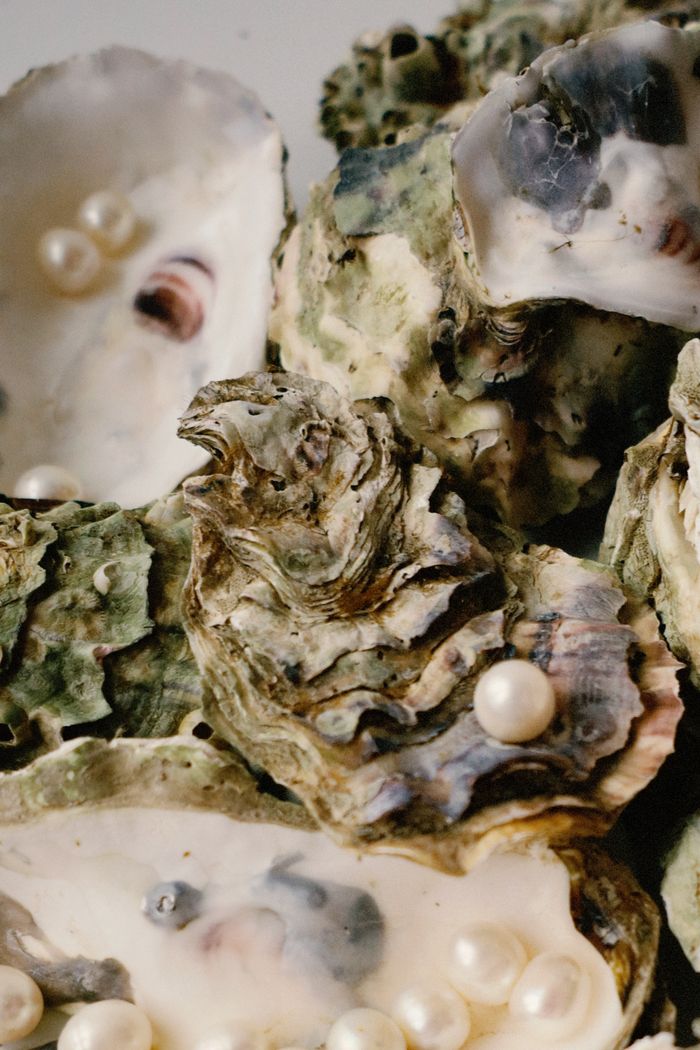
1. Raising Healthy Mussels: The Process Starts Long Before a Pearl Is Formed
Before a pearl can be implanted, there has to be a healthy host mussel.
Freshwater pearl farms typically raise mussels in ponds, lakes, or other managed freshwater environments. In China, for example, species such as Hyriopsis cumingii and Cristaria plicata have long been used for commercial freshwater pearl production. Hyriopsis cumingii, commonly known as the triangle sail mussel, is particularly important in Chinese freshwater pearl farming.
Young mussels are raised until they reach a suitable size and condition for implantation. This stage matters more than it might seem. A mussel that is weak, stressed, or poorly conditioned may have a harder time recovering from the procedure or retaining the implanted tissue.
Pearl farmers therefore pay close attention to water quality, temperature, food availability, stocking density, and the overall health of the mussels.
The goal is simple: start with a strong host that can survive the implantation procedure and spend the next several years producing nacre.
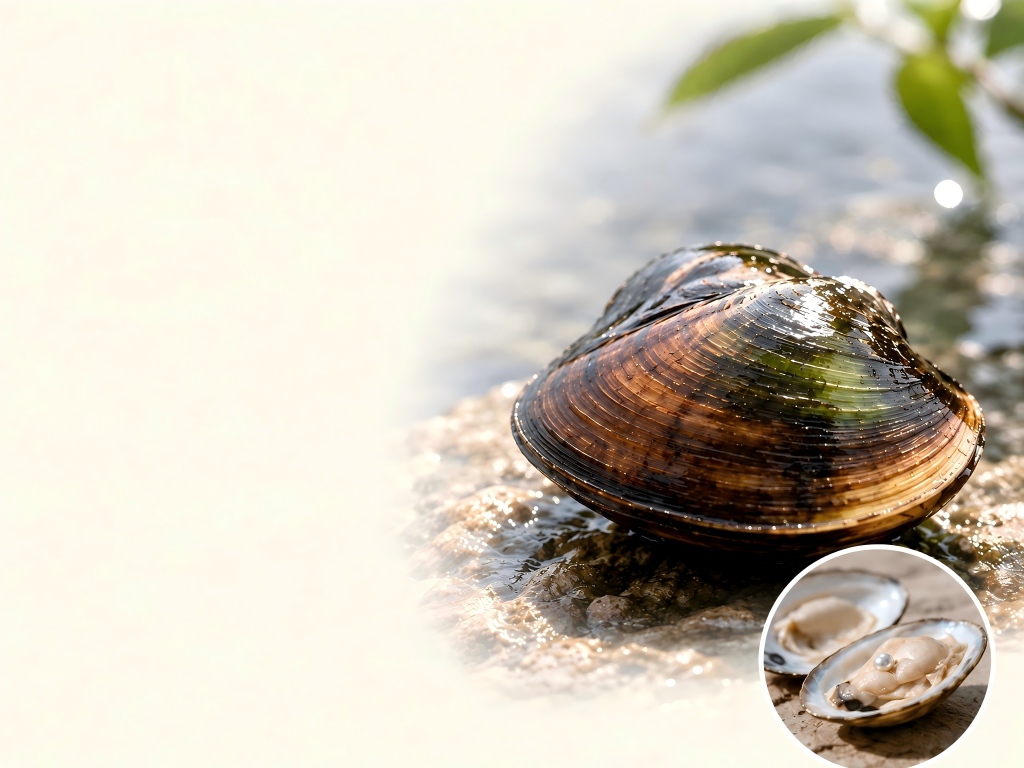
2. Implantation: Giving the Mussel a Starting Point
Once the mussels are ready, skilled technicians perform the most delicate part of the process: implantation, often called grafting or nucleation.
The technique varies depending on the type of freshwater pearl being produced.
Tissue-Nucleated Freshwater Pearls
For traditional tissue-nucleated freshwater pearls, there is no hard bead at the center.
Instead, a technician takes a small piece of mantle tissue from a donor mussel and carefully inserts it into the host mussel.
The mantle tissue is important because it contains the cells responsible for forming nacre. After implantation, those cells develop into a pearl sac. The pearl sac then begins secreting nacre, gradually building the pearl layer by layer.
This is one of the most interesting things about freshwater pearls: the implanted tissue provides the biological starting point, but the host mussel does the actual work of building the pearl.
A single freshwater mussel can receive multiple tissue grafts, allowing it to produce several pearls at the same time. The exact number depends on the mussel, the implantation technique, and the farming operation.
Because the procedure is delicate, the technician has to place each graft carefully and consistently. The mussel then needs time to recover before it is returned to its long-term growing environment.
Bead-Nucleated Freshwater Pearls
Freshwater bead-nucleated pearls can be divided into two main types based on where the nucleus is implanted: large, single-nucleated pearls commonly known as Edison pearls, and smaller pearls commonly marketed as freshwater AK.
Edison Pearls
Edison pearls are large freshwater cultured pearls produced by implanting a relatively large bead nucleus into the mussel’s foot tissue. Typically, only one pearl is grown in each mussel.
Because each mussel is used to grow a single large pearl, Edison pearls are generally much larger, typically ranging from 9 to 18 mm in diameter. Their key characteristics include good roundness, strong luster, thick nacre, and a wide range of vivid colors.
In addition to the white, pink, and orange tones commonly found in freshwater pearls, Edison pearls can also develop highly saturated purple hues.
Freshwater AK
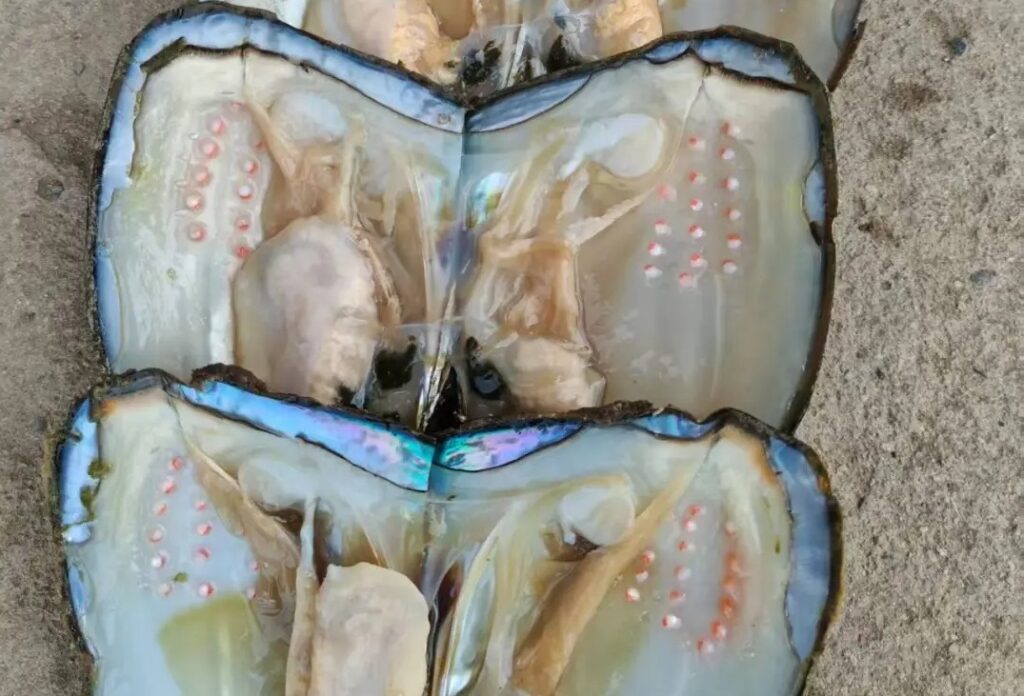
Freshwater AK is short for freshwater Akoya and refers to small bead-nucleated freshwater cultured pearls. Unlike Edison pearls, multiple small bead nuclei are implanted into a single mussel, often more than a dozen and sometimes around twenty.
Freshwater AK pearls typically range from 3 to 9 mm in diameter. High-quality white freshwater AK pearls can closely resemble Japanese Akoya pearls in shape, appearance, size, and luster. Their primary color is white, although purple, pink, and orange varieties are also available.
The name “freshwater Akoya” describes their appearance rather than their origin. Freshwater AK pearls are grown in freshwater mussels, while Japanese Akoya pearls are produced by marine oysters.
3. Recovery: The Mussel Needs Time to Heal
Implantation is only the beginning.
After surgery, the mussels need a period of recovery before they can settle into long-term cultivation. Farmers monitor them for signs of stress, rejection, or other problems and remove mussels that fail to recover.
This stage can have a major impact on the eventual harvest. Not every implanted mussel will successfully retain its graft or nucleus, and not every retained graft will develop into a commercially valuable pearl.
That uncertainty is one reason pearl farming is such a long-term process.
Once the mussels have recovered, they are transferred to their growing environment.
4. Growing Pearls Underwater: Years of Nacre Deposition
Now the real waiting begins.
Mussels may be kept in hanging cages, net cages, ropes, or other cultivation systems suspended in the water. Some farms also use bottom-culture methods. In Chinese freshwater pearl farming, hanging cage systems are widely used, and mussels may be cultivated alongside fish as part of integrated aquaculture systems.
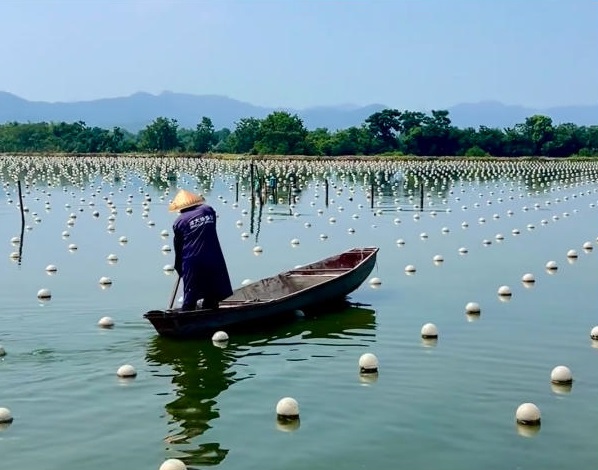
The exact farming method varies from one region and farm to another, but the principle is the same: keep the mussels in a healthy environment while giving them enough time to produce nacre.
And nacre is what makes a pearl a pearl.
The mussel’s mantle tissue forms a pearl sac around the implanted material. The cells lining that sac secrete nacre, building one microscopic layer after another. Over time, these layers accumulate and gradually form the finished pearl.
A pearl does not appear overnight.
Depending on the species, cultivation method, pearl size, and farming conditions, freshwater pearls may remain in the mussel for several years. For example, GIA documentation of bead-nucleated freshwater pearls in Japan describes cultivation periods of roughly three to four years for large pearls.
During this time, farmers have to keep an eye on the mussels and their environment.
Water quality matters. Temperature matters. Food availability matters. Predators, disease, excessive fouling, and sudden environmental changes can all affect mussel survival and pearl development.
The farming environment also influences the quality of the nacre. A healthy mussel living in suitable water has a better chance of producing smooth, well-developed nacre and attractive luster.
This is why freshwater pearl farming is not simply a matter of putting mussels in water and waiting.
5. The Pearl Develops Layer by Layer
Inside the mussel, the pearl continues to grow.
The process is surprisingly similar to adding extremely thin layers of paint—but on a microscopic scale.
The pearl sac repeatedly deposits nacre around the implanted tissue or nucleus. Each layer is incredibly thin. Thousands of these layers can eventually build up into a pearl with its characteristic surface, color, and luster.
The way those layers are deposited affects the final appearance.
When the nacre is smooth and evenly deposited, light can interact with the layers in a way that produces strong, attractive luster. When the surface develops irregularities, pits, wrinkles, or other imperfections, the pearl may appear less reflective.
The final shape is also influenced by the cultivation method.
Tissue-nucleated freshwater pearls can develop into a wide range of shapes, including round, near-round, oval, button, drop, and baroque forms. Bead-nucleated pearls tend to provide a more defined starting shape and can therefore be used to produce larger, more symmetrical pearls.
In other words, farmers can influence the process—but they cannot completely control the final result.
6. Harvesting: The Best Time to Collect the Pearls
Eventually, the mussels are ready for harvest.
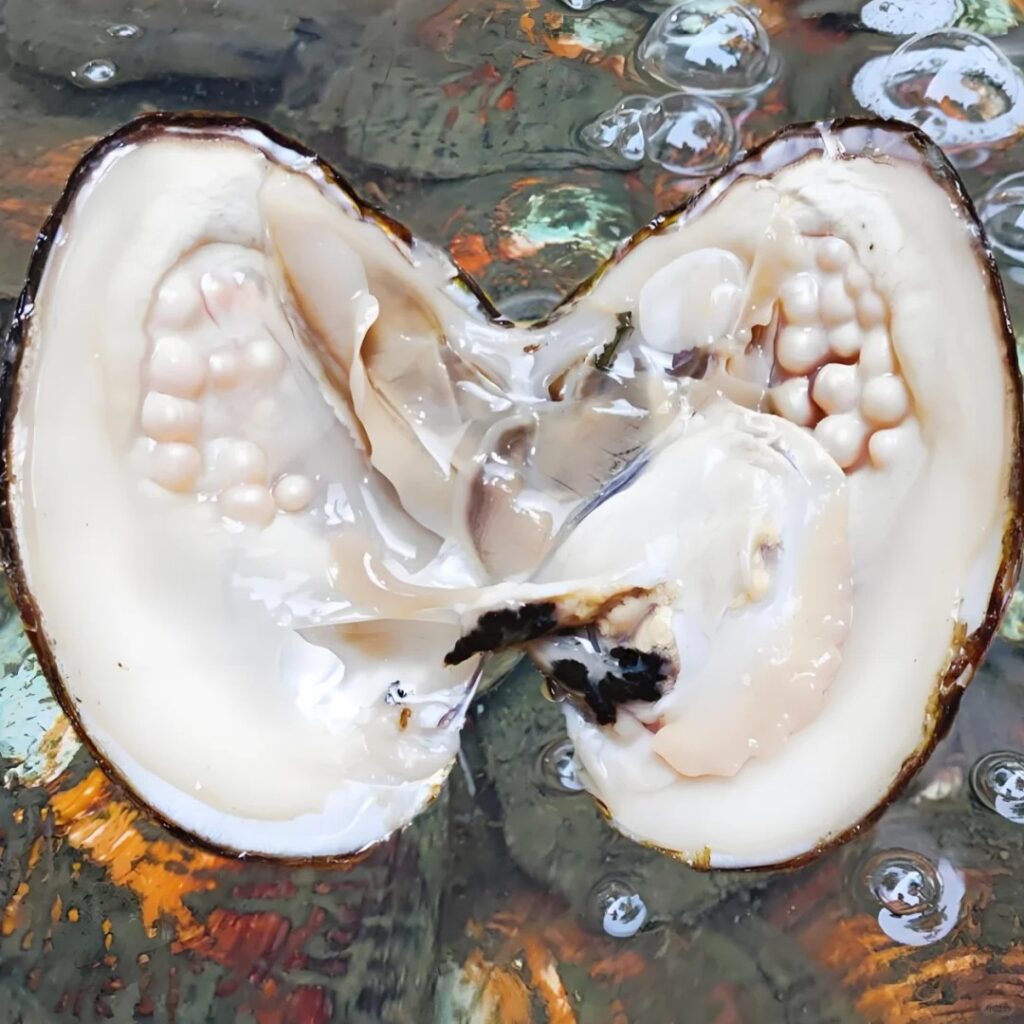
For freshwater pearls, harvesting is generally carried out from late in the year through the beginning of the following year, typically from November to February. Farmers generally avoid harvesting during the hot season because temperature can affect how nacre is deposited.
In warmer conditions, nacre is deposited more quickly, but the resulting layers can be less dense and refined. The surface of the pearl may develop a whitish coating, which can make the pearl look dull and reduce its luster.
During the winter or under cooler conditions, the mussel secretes nacre more slowly. The outer layers of nacre can therefore become finer and smoother, resulting in better surface luster.
For this reason, the cooler months are generally considered the best time to harvest freshwater pearls.
7. Sorting and Grading: The Harsh Reality of Pearl Selection
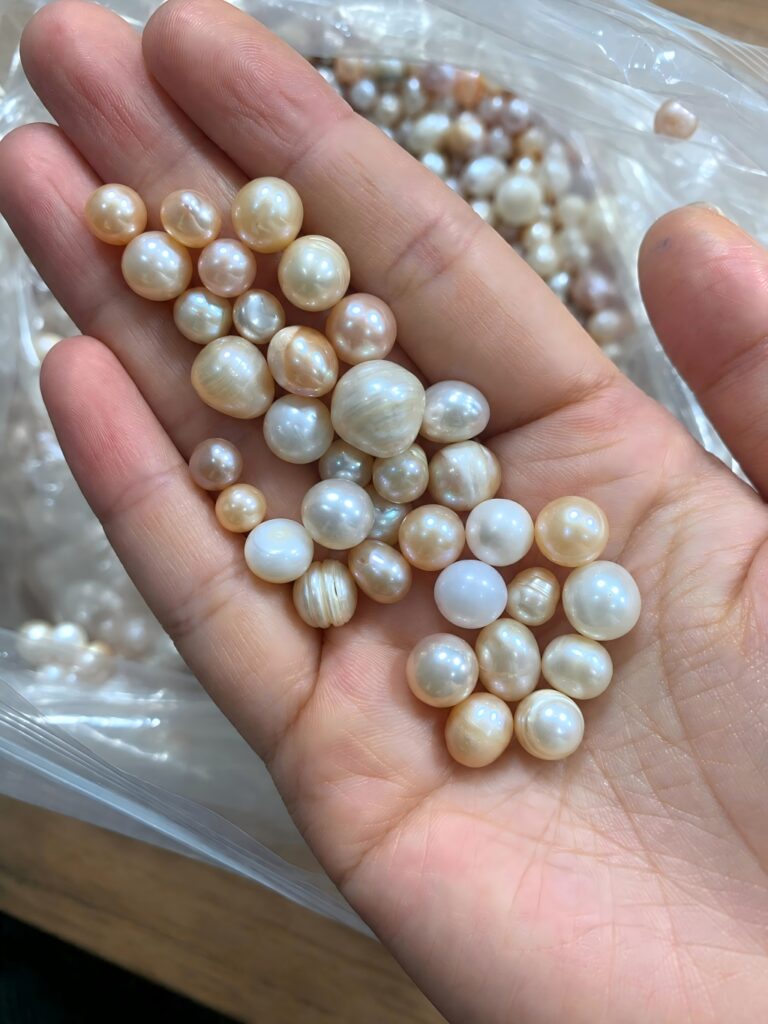
Once the pearls have been cleaned, they face another, often brutal stage: sorting and grading.
For traditional tissue-nucleated freshwater pearls, the percentage of truly round pearls can be surprisingly low. In our experience, finding pearls with a good round shape is one of the biggest challenges after harvest.
Bead-nucleated freshwater pearls generally have a much higher chance of developing a round shape. The reason is fairly easy to understand: there is already a round bead nucleus inside the mussel guiding the shape of the growing pearl.
Think of it like working with dough. If you wrap a layer of dough around a perfectly round ball, it is much easier to end up with a round shape than if you try to form a perfectly round ball from a piece of dough with your bare hands. The same basic idea applies to pearl formation.
Natural pearls follow a similar logic. Without a pre-shaped bead nucleus, the final shape depends much more on how the pearl-forming process develops inside the mollusk.
And shape is only one part of the selection process. After harvest, pearls may show unusual surface patterns, spots or blemishes, areas of weaker luster, and other imperfections. From our experience, it would not be an exaggeration to say that 90% or more of the harvested pearls may fall into the category of “problem” pearls in one way or another.
That does not mean these pearls have no value. Some irregular, baroque, or naturally patterned pearls can be beautiful in their own right. But for jewelry that requires round, clean, and closely matched pearls, the selection process can be extremely demanding.
Only after this careful sorting can the pearls move on to the next stage: becoming finished jewelry.
A pearl that spent years growing inside a living mussel may eventually become a pair of earrings, a ring, a necklace, or another piece of jewelry.