
A freshwater pearl does not become a piece of jewelry immediately after it is harvested.
From the moment a pearl is removed from a cultured freshwater mussel, it begins a careful journey that involves sorting, cleaning, preparation, matching, and skilled craftsmanship. Each step can influence the pearl’s final appearance, durability, and value.
For freshwater pearl producers, the process is not simply about turning loose pearls into jewelry. It is about identifying the unique characteristics of each pearl and selecting the right materials for different designs.
A necklace, pair of earrings, or pearl ring may contain only a few carefully selected pearls, but those pearls often come from a much larger harvest. Understanding how freshwater pearls are processed helps explain why pearls of similar size can have very different quality and price levels.
Step 1: Harvesting and Sorting Pearls
The journey begins when cultured freshwater pearls are harvested from mussels.
China has been the world’s leading producer of freshwater pearls for many years, with extensive experience in pearl cultivation and processing. After harvesting, pearls may carry moisture, organic residue, and other materials from the mussel and growing environment. Initial cleaning and proper handling are therefore important before the pearls move into grading and processing.
A single harvest can contain pearls with significant differences in size, shape, color, luster, and surface condition. Sorting helps separate these pearls according to their characteristics and determine the most suitable use for each one.
Traditionally, much of this work was done by hand by experienced pearl workers. Today, commercial pearl processing often combines manual inspection with specialized sorting equipment. Automated sorting systems can process hundreds of pearls per minute and help separate them according to visible characteristics such as size and shape, making them particularly useful when large quantities of pearls need to be processed.
Human expertise remains important throughout the process. Because freshwater pearls are natural products, individual pearls can vary considerably, and experienced workers are needed to make final selections and determine which pearls are best suited to different jewelry designs.
In China, pearl evaluation may also refer to standards such as GB/T 18781—2008. These standards provide a framework for evaluating pearl characteristics, but in practical production, sorting is ultimately about matching the right pearls to the right application.
The detailed characteristics used to evaluate pearl quality—including color, size, shape, luster, and surface quality—deserve a closer look of their own and are covered separately in our guide to freshwater pearl quality and grading.
Step 2: Cleaning, Preparation, and Processing
After sorting, the pearls move into a series of preparation and processing steps that make them suitable for jewelry production. Cleaning comes first, followed by preparation, drilling, and other processing as required by the pearl’s intended use.
Cleaning and Preparing the Pearls
Freshly harvested freshwater pearls may still carry natural fluids, organic residue, and other material from the cultivation and harvesting process. Before they can be drilled, matched, or assembled into jewelry, they need to be cleaned and properly prepared.
In the cleaning process, the pearls are soaked in a neutral detergent solution for 24 hours and kept in a dark place away from direct light during this period. Direct sunlight can affect the calcium carbonate structure in the outer nacre layer and may reduce the long-term stability of the pearl’s luster. After soaking, the pearls are rinsed three times with distilled water to remove any remaining detergent residue.
Careful handling is important throughout the process. Freshwater pearls have a natural nacre surface, so cleaning is intended to remove residue without unnecessarily affecting the surface of the pearl. Once cleaning is complete, the pearls can move on to the next processing stage, such as drilling, matching, or other finishing work.
Drilling Freshwater Pearls
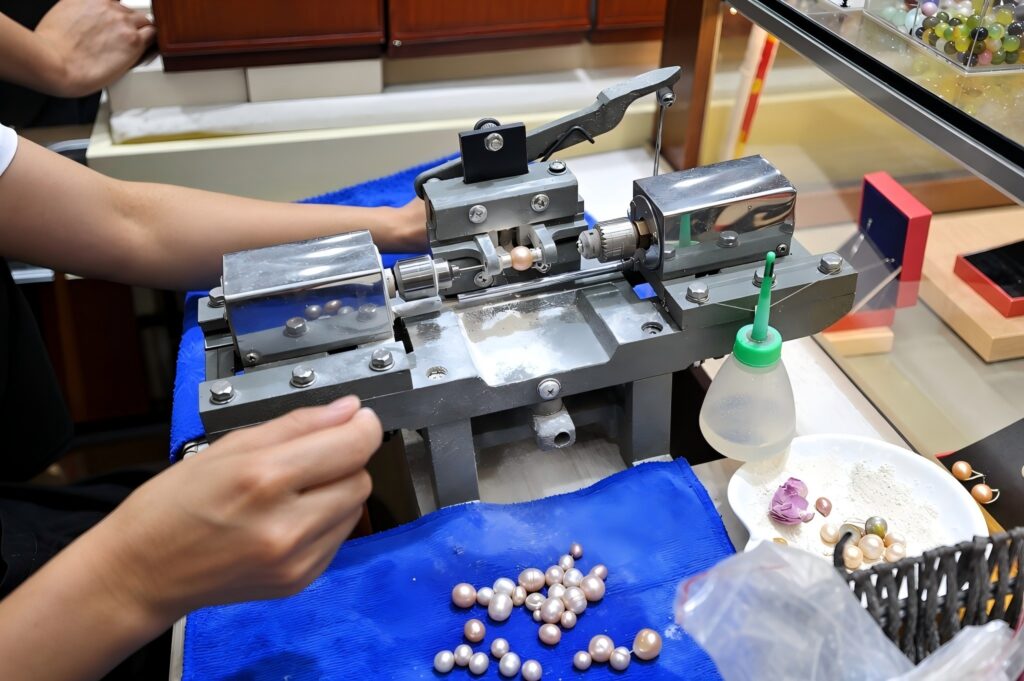
Drilling is one of the most precise steps in pearl jewelry production. Although creating a hole may seem straightforward, freshwater pearls are relatively delicate, and an incorrectly positioned or oversized hole can weaken the pearl or affect how securely it can be assembled into jewelry.
The type of hole depends on the jewelry design. A full hole passes completely through the pearl and is commonly used for necklaces and bracelets. A partial hole is used when the pearl needs to be attached to a finding, such as in earrings, pendants, or rings.
The position of the hole is particularly important. During production, the drilling point should avoid visible blemishes and other weak areas whenever possible. The hole diameter also needs to be controlled carefully, with an allowable variation of about 0.1 mm. If the hole is too large, too small, or incorrectly positioned, the pearl may not fit the jewelry component properly and can be more vulnerable to damage during stringing or assembly.
Production experience also shows how much a small deviation can matter. A drilling-position deviation of just 1 mm can increase the risk of pearl breakage by approximately 40%. For this reason, drilling requires careful positioning based on the pearl’s shape, surface condition, and intended jewelry application.
Purifying Freshwater Pearls
After drilling, the pearls undergo a purification process to remove impurities and further prepare them for jewelry production. Purification can be divided into natural purification and technical purification, depending on the condition of the pearls.
Natural purification involves placing the pearls in a temperature- and humidity-controlled environment and allowing them to rest for seven days. During this period, the pearls naturally release impurities without the use of chemical treatments.
Pearls with dull luster or noticeable discoloration may require technical purification. In this process, the pearls are soaked in a diluted solution of hydrogen peroxide combined with a mildly alkaline solution. The concentration of the solution is critical. If the concentration is too low, it may not remove impurities effectively. If it is too high, it can corrode the outer surface of the pearl and affect its appearance.
After technical purification, the pearls are placed in an ultrasonic cleaning machine for 10 minutes to remove any remaining solution. This final cleaning step helps ensure that chemical residues are removed before the pearls proceed to subsequent processing.
Step 3: Pearl Treatments, Finishing, and Surface Care
After pearls have been cleaned and prepared, some may undergo additional finishing processes depending on their quality, intended use, or desired appearance.
These processes should be understood as part of commercial pearl production rather than as a replacement for natural pearl formation. A pearl’s fundamental beauty comes from its nacre structure, surface quality, and natural characteristics developed during cultivation.
Enhancing Pearl Appearance
A pearl’s luster is mainly created by the quality of its nacre and the way light interacts with its layered structure.
Careful cleaning, handling, and finishing can help reveal a pearl’s existing luster and improve how it appears when used in jewelry. However, processing cannot create the same depth and reflection found in naturally high-quality pearls.
This is why experienced pearl professionals focus on selecting pearls with strong natural qualities rather than relying only on post-harvest treatments.
For colored freshwater pearls, appearance evaluation requires additional attention. Some colors occur naturally, while others may result from treatments such as dyeing or other enhancement methods.
When evaluating treated pearls, professionals may examine areas such as drill holes, surface features, or color consistency. In some cases, treated color may appear stronger around areas where the pearl has been processed.
A treated pearl can still be attractive and suitable for jewelry. The key point is transparency. Buyers should know whether a pearl’s color is natural or enhanced so they can make informed decisions.
Surface Protection and Pearl Care Considerations
Some pearls, especially those with more delicate surfaces, require careful handling during production and jewelry assembly.
The durability of a pearl depends on many factors, including nacre quality, surface condition, and how the finished jewelry is worn and maintained. Unlike harder gemstones, pearls can be affected by chemicals, cosmetics, perfume, and repeated friction.
For this reason, pearl jewelry should always be handled with appropriate care.
Treatments such as dyeing, irradiation, coating, or other surface modifications may influence how a pearl should be maintained over time. This does not automatically reduce the value or beauty of a pearl, but it does make accurate product information especially important.
A professional pearl supplier should provide clear descriptions of pearl characteristics and any treatments that may affect appearance or care requirements.
Step 4: Matching Pearls and Creating Jewelry Designs
After pearls have been cleaned, prepared, and processed, they enter one of the most important stages in jewelry production: matching.
A single pearl can be beautiful on its own, but creating a harmonious jewelry piece requires careful selection. This is especially true for pearl earrings, necklaces, and bracelets, where multiple pearls need to work together visually.
Matching involves comparing pearls based on characteristics such as size, shape, color, luster, and surface appearance. The goal is not always to find pearls that are completely identical, because natural pearls rarely are. Instead, experienced pearl workers select pearls that complement one another and create a balanced overall appearance.
For pearl earrings, matching is particularly noticeable. Even a small difference in size, tone, or luster can affect how balanced the pair appears when worn.
For traditional round pearl necklaces, consistency becomes even more important because each pearl is displayed next to the others. A well-matched strand creates a smooth visual flow from one pearl to the next.
However, matching does not mean every pearl must be exactly the same. For baroque and other irregular freshwater pearls, natural variation is part of their beauty. In these designs, the focus is on creating harmony between unique shapes, colors, and surface characteristics.
Experienced pearl professionals often use controlled lighting conditions when comparing pearls because subtle differences in luster and color can be difficult to judge under inconsistent lighting.
Turning Loose Pearls Into Finished Jewelry
Once pearls have been selected and matched, they are ready to become finished jewelry pieces.
The assembly process depends on the type of jewelry being created. A pearl necklace requires different techniques from a pearl ring or pair of earrings, but every design requires careful craftsmanship to ensure both beauty and durability.
Stringing Pearl Necklaces and Bracelets
Pearl necklaces and bracelets are traditionally created by stringing pearls onto strong, flexible thread.
In many classic pearl designs, knots are tied between individual pearls. These knots serve several important purposes. They help prevent pearls from rubbing directly against each other and provide additional security by reducing the chance that all pearls will be lost if the thread breaks.
Stringing also requires careful control of tension.
If the thread is too loose, gaps may appear between pearls and the strand may look uneven. If the thread is too tight, the necklace may not move naturally and could place unnecessary stress on the pearls and thread.
A well-made pearl strand should feel comfortable to wear, maintain a smooth shape, and allow the pearls to move naturally together.
Setting Pearls Into Earrings, Rings, and Pendants
Pearls used in earrings, rings, and pendants are usually secured with metal settings rather than stringing.
Depending on the design, pearls may be attached using posts, cups, caps, or other jewelry components. The setting must hold the pearl securely while allowing its beauty to remain visible.
Because pearls are softer than many gemstones, setting design is especially important. A good setting protects the pearl while avoiding unnecessary coverage of the surface.
The type of jewelry also affects how much care the pearl requires. For example, a pearl pendant may experience less direct contact than a pearl ring, which is more exposed to daily activities, surfaces, and accidental impacts.
This does not mean pearl rings cannot be worn regularly. It simply means that different pearl jewelry designs have different care considerations.
Final Finishing and Quality Control
Before freshwater pearl jewelry reaches customers, it goes through a final inspection process.
Quality control helps ensure that the finished piece meets the expected standards for appearance, construction, and durability.
For pearl strands, the final inspection may include checking:
- Pearl matching and overall balance
- Spacing between pearls
- String tension
- Knot quality
- Clasp security
- Consistency of luster and color
For earrings, rings, and pendants, inspection may focus on:
- Pearl alignment
- Setting security
- Design symmetry
- Overall finishing quality
A professionally finished piece should not only look beautiful but also feel secure and comfortable when worn.
The final jewelry represents the combined result of many earlier decisions—from pearl cultivation and harvesting to sorting, processing, matching, and craftsmanship.
Why the Pearl Production Process Matters When Buying Freshwater Pearl Jewelry
Many buyers initially focus on simple measurements such as pearl size or the type of metal used in the setting. However, the value and beauty of freshwater pearl jewelry depend on much more than size alone.
Two necklaces may both feature 7 mm freshwater pearls, yet appear completely different when viewed side by side.
One necklace may contain pearls with stronger luster, more consistent color, smoother surfaces, and careful matching throughout the strand. Another may use pearls of the same size but with weaker luster, greater variation, or more visible surface characteristics.
The difference comes from the quality of the pearls and the care taken during every stage of production.
The same applies to pearl earrings. A carefully matched pair can create a more refined and balanced appearance than two pearls that simply share the same measurement.
When choosing freshwater pearl jewelry, buyers should consider several factors together:
Luster — Does the pearl reflect light clearly and appear lively?
Surface quality — Are natural marks acceptable for the style and price of the jewelry?
Color — Is the color natural or has the pearl been treated?
Matching — Do the pearls work well together as a pair or strand?
Shape — Does the pearl shape fit the intended jewelry design?
Craftsmanship — Are the pearls securely strung or properly set?
Product information — Does the seller clearly explain pearl characteristics and any treatments?
Understanding these details helps buyers make more informed decisions and appreciate why carefully produced freshwater pearl jewelry can offer lasting beauty.
From Harvested Pearls to Timeless Jewelry
A freshwater pearl begins its journey inside a mussel, but many skilled steps are required before it becomes a finished piece of jewelry.
Harvesting provides the raw material. Sorting identifies each pearl’s unique qualities. Cleaning and preparation help reveal its natural beauty. Drilling, matching, and craftsmanship transform individual pearls into wearable designs. Final inspection ensures that the completed jewelry meets quality expectations.
Every pearl carries the story of its formation, and every finished jewelry piece reflects the care taken throughout the production process.
By understanding how freshwater pearls become jewelry, buyers can look beyond size and price and better appreciate the qualities that make each pearl unique.